Monday, April 14, 2025

Rivers/Davis Family History "Of Men and Events"

Your GrandNana Phyllis McCausland Rivers was a woman of many skills and interests.  These included cooking/baking (over a coal stove in the early years of her marriage, which she understandably complained about), gardening, sewing, knitting, traveling and volunteering such as for Planned Parenthood and United Way.  And being a minister's wife, an unofficial job with numerous responsibilties especially at a prominent church like St. Stephen's in Wilkes-Barre.  Also, as an intellectual graduate of Radcliffe College (sister school to Harvard, where Great Grandad studied) and intrigued by family history.  Here is a photo of GrandNana and Great Grandad, from sometime in the 1960's.  Then followed by a cheerful picture of her at Christmas, 1990 with Uncle John.


For years, GrandNana was a member of the Thursday Club.  This was a women's group in our local area that met regularly during the afternoon, taking turns at each other's houses.  Everyone was well-dressed.  The hostess would prepare a research paper on a topic and present it to the group.  After a discussion, it was on to a traditional English tea.  This was quite an undertaking for Nana, and when I lived with her during my college years I was drafted to help serve.  A classic, silver tea set (polished before the occassion) was used - similar to the one below.  In addition to tea and coffee, there were cold drinks like ice tea and lemonade.  And of course, tea sandwiches, cakes and cookies.  You probably didn't know our family could be so Proper !  (Seriously, your great grandmothers on the Rivers and Zeller sides were quite adept at formal socializing.)


Last year, your (Great) Aunt Ginny passed along a number of Rivers family records.  In this treasure trove of family documents, pictures, newspaper articles, mementos, etc. was a copy of GrandNana's 1987 paper from Thursday Club.  It's about family origins of your Great Grandad Burke Rivers, along the Maine coast.  You may know that your (Great) Uncle Dick's full name was Richard Davis Rivers.  I'm copying the full paper at the bottom of this post; it was handwritten, and Grammie recently took time to transcribe it.  GrandNana did a great job weaving together historical events with family lore.  I've included a few of my own notes in the bullets below:

  • Londonderry - From which Joseph Rivers came to Massachusetts (Maine territory), then an English colony, in 1730.  Seems most likely to be the city in Northern Ireland, now known as "Derry", which is much larger than a different village of Londonderry in northeast England.  Londonderry Ireland has a complicated history.  It was originally called "Derry" when settled by the O'Neills, a Gaelic tribe.  In the early 1600's the English, wanting to exert control over the resistant Irish (catholic) population, established a settlement there.  Many English and Scottish (protestants) then relocated to the province of Ulster, including Derry/Londonderry.  
  • Genoa, Italy - From which Samuel Davis (Guarnieri?) came to Maine in 1813-14.  It was historically one of the most important ports of the Mediterranean Sea.
  • "....work lunars as well as Bowditch himself..." - This is referenced in the 3rd paragraph from the end, related to rigors of ocean navigation.  Nathaniel Bowditch wrote a book New American Practical Navigator published in the early 1800's, which was used universally by American sailors through the century.  Working lunars means using the moon - much as the hands of a clock - moving against the background of the sun, the stars, and the planets.  In "taking a lunar", the navigator uses a sextant to measure the angle of the moon with the sun, stars, and planets.

Of Men and Events

Phyllis Rivers

Thursday Club                                                                                                    April 9, 1987


This paper is an act of compromise. This was to be the year of sabbatical leave for Molly and me. Certain of our members could not prepare papers this year (for very good reasons) so I agreed to write one if I could use the material on which I have been working: records and information about Burke’s family and mine; and Molly graciously l offered to have the tea. This was compromise #1.

The problem of how to fit my material of personal and limited interest into the category of “Events’ brought compromise #2. It consisted of fitting the biographical data of two men into the events of their times.

 The two men are Joseph Rivers, the first of his line to come to the coast of Maine who arrived in 1730. The other is Samuel Davis who came to the same village on the St. George peninsula, Tenants' Harbor, in 1813 or 1814. Their lives were about a century apart.

About Joseph Rivers we know very little. He is recorded as one of a group brought from Londonderry to replace settlers on the Maine coast who had been massacred by French and Indians from Canada in the long effort to secure Maine (then a part of Mass.) for France, accomplishing this by killing off English colonists. We know this period as that of the French and Indian wars, part of a European set of wars. Joseph Rivers was one of the St. George Plantation. So we know only this much: when he came, why he came, whence and where he came. Beyond that we cannot go. Maybe he was a soldier destined to reman the fort at the mouth of the St. George River, which is family legend, or maybe he was a farmer with the job of bringing the land again under cultivation. He may have been married already when he came, or he may have married the daughter of a family in the group. When we come to consider the situation into which he came, we will be able to take some sound guesses about what his life was like.

I know much more about Samuel Davis. His cemetery monument says he lived from 1808 to 1894. He had 14 children by two wives, 13 by one and one by the second wife (Hooper.) This youngest, Aunt Ida, we knew. Her name was Ida Davis Rivers, daughter of Samuel Davis and married to Weston Rivers, a descendant of Joseph Rivers. They lived in the Davis homestead and we visited there many times. Burke shared in the final settlement of the Samuel Davis estate, divided after our retirement, among the heirs who could be found, heirs of 14 children. His part was $247.68.

All this is beside the point. Samuel Davis is buried in Martinsville Cemetery (the village of Sarah Orne Jewett’s “Land of the Pointed Firs”). But his name was not Davis. It was Guarnieri, or something which sounded like that. No one really knows.

Aunt Ida, his youngest child, told us what I know: that a little boy of 6 or 7 and his father had arrived at Tenants’ Harbor on a sailing vessel which they had boarded at Genoa. The little boy was to become her father. Why had they left Genoa? We don’t know. Perhaps the mother had died and the father was seeking a new life in a new land. Perhaps the father had political reasons for leaving. It was the period of the height of Napoleon’s expanding conquests (1813 or 1814) and Napoleon had just annexed Genoa and the Piedmont to France.

Samuel Eliot Morison says in “The Maritime History of Massachusetts” that Genoa was a regular port of call for Indiamen (around the world sailing vessels, traders) on their way home to Massachusetts and Maine.

It is understandable that the father should decide to discard the Italian surname and, so the tale goes, he took the name of the first land sighted as they approached Port Clyde. The land was Davis Island. The father had the means to buy land and a house. So we have a small Italian boy growing up in a Maine village, Tenants' Harbor, with the name of Sam Davis - American enough.

Tenants’ Harbor is a pleasant village on a good harbor on the east side of the St. George peninsula. Burke’s Uncle Mel Hart told us that when he was a boy there Tenants’ Harbor was home port to about 100 sailing ships which went over the seas to China, India, the Mediterranean ports and our own West Coast. Parenthetically, Uncle Mel told us that in those days no man owned his own vessel; he owned 1/10th of 10 vessels, thereby ensuring himself against loss in case of disaster at sea or an unprofitable voyage, as well as benefiting from the profit of a good voyage. Morison said the 1/16th was a more common division of ownership on larger vessels.

Like other boys in the village, Sam probably went to sea at the age of 10 or 11, serving as cabin boy, cook’s helper, then moving along to more responsibility as second mate, first mate, finally master or captain. To go to sea and become master of a vessel involved an on-the-job education in navigation, handling of men as well as of the ship, a knowledge of trading. It was a respected and demanding calling, requiring intelligence and good judgment. I do not know at what age Samuel Davis commanded his own vessel. I only know one certain fact: that the log of a voyage he made to the “China Seas” is in the archives of the Maine Historical Society in Portland.

I used to tease Burke about how he could have 14 children and be at sea for long voyages. It may be that his wife and children went with him. That was not uncommon. Fourteen children there surely were, for in Aunt Ida’s parlor (I mean Parlor) was a large framed grouping of photographs, each one separate, of 14 men and women. The men were well-set-up, mustachioed in the walrus manner; the women looked dour, with hair parted in the middle and drawn back (they were no nonsense women). Our son David could be one of them; he looks like them. The frame was scrimshaw; doubtless made on a long sea voyage.

He finally abandoned the long sea voyages, changing to coastal trading. A common load at that time could have been ice, lumber, salt fish, maybe Rockland lime, from Maine to Havana, or one of the West Indies, then back with molasses to Medford, Mass. where it was turned into rum. Or maybe the trip took him for Savannah for cotton, or to New Orleans. A master took from Maine what was available land did his trading as he could.

Our son David has a Civil War rifle which Capt. Davis is supposed to have found on a battlefield near Norfolk after the Civil War. He (Capt. Davis) remade the stock which may have been damaged, and used it for hunting. So he must have put in at Norfolk at least once.

Both deep sea and coast-wise trading must have been profitable for when Capt. Davis died he left a property to each of his children. Aunt Ida inherited the family home, a pleasant Cape-Cod cottage with additions, what the down-Easters call a woman-killing-house: first the main house, then attached and strung out, the kitchen-pantry ell, the wood shed, the chicken house, finally the barn. In a winter storm or on a rainy day a man could lend all his chores without going out of doors.

At some point Capt. Davis retired from going to sea and settled into being a man-of-all-trades: a wheel-wright, a gun-smith. He built a shop on his own land right beside the road. We saw it first about 1940, untouched, literally, since his death in 1894, with his tools and patterns still as he had left them. There is a rumor that he operated a grist mill on a tidal salt pool on his property. There is evidence of a tide-water mill having existed there and such mills were not uncommon.

I would call a man of parts, certainly remembered with love and admiration by his daughter.

She remembered that he always wore small gold-loop earring and a black brimmed sailor hat. So he was still a little bit the Italian boy.

Every person’s life is shaped by the events of the time into which he/she is born. For me the events have been two World Wars and a cataclysmic depression. Wars and a cataclysmic depression. You know the events which have determined the course of your life.

The rivalry of the French and English for occupation and power in the Old World (break-up of Empire of Charles V ) and for trade and territory in the New World presents the key to the 75 years of warfare known to us as the French and Indian Wars. This was the shaping force for Joseph Rivers’ life.

At first the Indians has been friendly toward the early English colonists, had traded with them for domestic utensils, cloth and guns, but the friendliness began to disappear as the Indians found themselves cheated in trade and finally cheated of their lands and perhaps worst of all, looked upon as an inferior race.

The French, in contrast, treated the Indians as brothers. They married Indian women and sat as friends at their council fires. The role of the Jesuit priests among them was friendly, teaching them Christian faith and better ways of living. Of course the French took advantage of the Indians to increase their own power, but they did it in such a way that the Indians were flattered and proud to ally themselves to the French cause.

About the year 1717 a strong and capacious fort was built on the easterly bank of the St. George River. A short distance from that a block-house was erected and the large area between was enclosed by palisades. This afforded ample accommodation for a garrison of two hundred and fifty men. In 1720 there were twenty houses, a few stores and two or three wharves near the stronghold.

The Indians felt that the fort was a direct threat to their hunting grounds and they continually prowled around it and attacked it whenever they could.

In May of 1724 there was a major attack on a group from the fort who had gone on a hunting trip. All were killed by a group of Indians waiting in ambush. In the summer of 1724 a large group from the fort made a retaliatory raid on an Indian village, coming upon them at siesta time and killing most of them.

The governor of Mass. (Dummer) devised a peace with the Eastern Indians and four chiefs went to Boston to sign the treaty. By this treaty the English bound themselves to keep trading posts on the principal rivers for the convenience of the Indians and the settlers were confirmed in their land titles by the Indians, who promised not to molest them on the land they had bought of the chiefs. The peace that followed was the most lasting since the Indian wars commenced.

Governor Dummer kept his word. Trading houses were established, one at Fort St. George on the St. George Rivers. With honest men in charge, the forts were well stocked with goods the Indians needed and wanted. The Indians were well satisfied with this trade and even Canadian Indians came because they received full value for their furs.

But the area needed to be repopulated. Joseph Rivers was one of these settlers.

In the spring of 1774 France joined Spain in another war against England. Soon the French in America took occasion to attack English settlers in Nova Scotia. On Cape Breton King Louis 1X of France had built a fort at Louisburg, considered the strongest fort in America. It guarded the ship channel to the St. Lawrence and consequently to the French holdings. From Louisburg the French had been harassing English shipping and fishing along the coast of New England. Gov. Shirley of Mass. and the colonial merchants felt that if they could capture the fort, they could break the French power and protect their shipping and fishing industries.

An armament of 4,120 men, vessels with transport and supply ships and only 200 guns was assembled, leaving Nantucket Roads in late March, 1745 and arriving at Canseau in Nova Scotia in May. All along the coast of Maine they added recruits of men willing to go along. It is estimated that half the men on the Maine coast went. Joseph Rivers may well have been one. Burke liked to think so.

In Canseau they were joined and strengthened by a squadron from the Royal Navy and as soon as the ice went out all proceeded to Cape Breton and Louisburg. They blockaded the harbor preventing aid from France from entering. Maj. Gen Pepperell of Mass. moved his troops into commanding positions overlooking the fort, doing it in a most unmilitary way which bewildered the French officers who believed the fort invulnerable. The colonial troops hauled their guns and ammunition over swampy lands which the French had thought impassable, using sledges devised by a Maine shipbuilder. The attack was from the rear of the Grand Battery; it surprised and overwhelmed the French forces and the commander surrendered. In England the news was received with astonishment and Pepperell was knighted

This victory was at great cost of both colonists’ lives and money and the colonists felt it was their victory, so it was an understandable cause of bitterness and disillusionment to them when in the treaty of Aix-la-Chapelle (1748) Louisburg and all other conquered lands were given back to the French by the English king in spite of the wishes of the people of New England who had fought so bravely and sacrificed so much. They had to do it all over again in 1758. Some historians believe that this episode sowed the first seeds of discontent on the part of the colonists which led to the War of the Revolution.

Samuel Davis arrived on the Maine coast at the height of the sailing ship. It was this, the pinnacle and the decline of the sailing ship, which shaped his life.

From earliest colonial days lumbering had been an important industry in Maine. The virgin forest was very old and through it stood pines to the height of 200-240 feet, straight and tall, unmatchable for the masts of large sailing vessels, ergo called “mast pine” or ”puncheon pine”.

During the long war with France the “Broad Arrow” policy was adopted whereby the king claimed for his navy all pine trees from two feet in diameter at 12 inches from the ground that were growing in ungranted land. Surveyors went through the forest and cut the “broad arrow” in trees reserved for the Royal Navy. Transport of these and other lumber, barrel staves, was made easy by swift rivers flowing to the loading places of sailing vessels for English fuel, smelting, ship-building.

In the early part of the 19th century Maine produced for export in addition to lumber, corn dried fish, horses and cattle and later ice. Lime from Thomaston. These became the staple products for the three-cornered trade to the Indies and back to the southern colonies and home.

Samuel Eliot Morison writes the ship building boom began about 1831 when Samuel Davis would have been a young man. In this year Maine overtook her parent Mass. in the building of sailing vessels. The great shipyards on the Kennebec, St. George (our territory) and Penobscot Rivers became serious competitors of the Mystic and Merrimac. Small coasting vessels were constructed along many shore harbors.

Very different types of vessels were needed for different routes and purposes. For the carrying of cotton from the South to northern mills, old-fashioned converging topsides were preferred. They increased stability for so light a cargo.

The finest type of the period was the East Indiaman, usually with a cargo carrying capacity of about 500 tons. They were freight carrying vessels, the fastest and most economical carriers of their generation. Clippers came later.

Their crews were in the most part Yankees. Wages were low: $8 a month for boys, $10 for ordinary seamen and $12 for able seamen, on long voyages. It was not uncommon for youngsters of good families to ship before the mast: (e.g., Richard Henry Dana). Sailors wore a distinctive costume: shiny black tarpaulin hat, red-checked shirt, Blue bell-mouthed dungaree trousers, navy blue pea jacket or watch coat. For shore leave, a fathom of black ribbon for the hat, black silk kerchief in a neat sailor’s knot around the neck, white ducks and black pumps.

It was a rough, demanding life. Nevertheless a foremast hand on a Yankee Indiaman was the best paid, best fed and most competent sailor in the world, regarded as the top dog of his profession. For the most part the commanders were men of high character and education; navigators who could work lunars as well as Bowditch himself and who inherited all the practical seamanship of the old school; “merchant-captains” who owned part of their vessel and had full responsibility in trading. We may fairly call the 1830’s and 1840’s the golden age of the American merchant marine.

Essentially the Civil War saw the end of the sailing ships and trade. Actually it merely hastened a process that had already begun, the substitution of steam for sail. Railroad expansion to the West and the protective tariff killed many lines of commerce. The profit had gone out of the carrying trade in sailing vessels. The era had come to an end.

It stretches the meaning of “Events” but this high era of sailing ships provided the events which constituted the life of Samuel Davis. He had seen the world and when the sailing days were over, his was a different life, and he survived the change.


Sunday, March 2, 2025

Old Time Cars (child of the 70's)

This is a joint post by Steve and me, for which he is providing more technical details - since he is a car person and I am definitely not.  One reason is that cars are less significant when living in a large city like Philadelphia, also the only vehicle I remember growing up is the Volkswagen bus (correctly called a "microbus").  Old Swedes Church provided a vehicle that was used for both church and our family transportation.  I don't know all the reasons why, but this ended up being 3 buses during the 1970's into the early 80's.  I don't find them attractive, probably since I spent TOO much time suffering in them.  But Steve (who rode in one a few times while working at a summer camp) kind of likes them, since they were functional, innovative and relatively fuel efficient.  There was no radiator to overheat, instead the engine was air-cooled.  In practical terms, power was being generated by a souped-up lawn tractor motor.  Below are pictures of VW buses in the 2 colors I remember we had.

A VW microbus will get you from point A to point B, but here's a litany of complaints.  As Steve points out, it's designed with a down-sloping front end so there was minimal protection for the driver or front passenger in an accident.  (Airbags did not become standard equipment until the 1990's.)  In addition, the steering wheel was sort of like a large serving tray.  In a head-on crash, the driver's ribs and knees could be crushed.  Luckily we had no accidents of note.  Typical of cars in the 1970's, there was no "power" anything including steering.  Manual steering is the earliest steering technology and it requires force to turn the wheel. This was physically difficult at low speeds - like when parking or pulling out.  Driving on the highway, the bus acted like a sailboat on windy days.  This model had a nasty tendency to develop gas tank leaks, so when this happened the people in the back seat were nauseus from fumes on longer trips....  of course, the older kids (Aunt Julie and me) were stuck there.  Seats were uncomfortable, and the panoramic windows barely opened.  There was no cooling in the summer, minimal heat in the winter and the power on hills was attrocious.  During camping vacations when Grandad drove up Red Rock mountain to Ricketts Glen park, we went about 25 miles per hour with other traffic crawling along behind us.  Quite humiliating, I wanted to scooch down so no one could see me.

Steve also has pretty specific memories of 1970's vehicles.....  which he began acquiring sometime in his high school years.  Per Steve, here are the many '70's vintage cars that he owned - in order.

  • 1974 Plymouth Duster, 2 door.  I owned this with my brother Rich.  It was pea green, but one of the front fenders was rusted out so we replaced it with a used part...that happened to be orange.  It literally looked like an Irish flag.  It was practically option-less, not even having carpeting (it had a giant rubber mat instead).  I eventually handed over my interest in the car to my brother.  I think about a year later the engine blew.

  • 1974 Plymouth Fury III, 4 door sedan.  This was probably my favorite car, ever.  360 cubic inch engine.  Very fast and very comfortable.  It was tan with dark brown vinyl tap. I ended up totaling it while driving on route 307 during a snowstorm (I was picking up my mother from where she worked).

  • 1970 Buick LeSabre, 4 door sedan.  It was black and bore a striking resemblance to the batmobile.  I sold it after about a year or two.

  • 1974 Chrysler Newport Custom, 4 door sedan.  This was the car I took away to college for my junior and senior years.  It was enormous.  How big?  Well, I've stayed in hotel rooms with less interior space.   440 cubic inch engine got about 10 miles to the gallon city.  I didn't drive down the road in it...I floated down the road.  The transmission eventually went bad...and this is the gospel truth...while driving home for the last time from college.  Talk about loyalty!

  • 1978 Chrysler LeBaron, 4 door sedan.  This was a great car, but it had one flaw: Whenever it rained the floor behind the driver’s seat would flood.  I kid you not.  I checked and it wasn't rotting under there, and the window seal was good, so who knows where the water came from.  The car was totaled in York PA while I was driving back from work by a guy who ran a stop sign. 

  • 1980 Dodge Colt, 2 door.  This was a great car, and I put a ton of miles on it.   I had this car while I worked for Bon Ton, buying it with the insurance money from the LeBaron wreck.  Traveling between the Bon Ton in Carlisle and Perry County I went through something like four sets of front brakes.  The transmission eventually died at about 160,000 miles or so in mid-1989 as I was just starting to work for Prudential in Florham Park, NJ.

  • 1974 Mercury Comet, 4 door sedan.  The worst car I have ever owned, hands down.  I was given this car by my brother Chris, as I needed something to drive (the Colt had died) while in NJ and I couldn't afford another car.  This was a wretched piece of crap that wasn't worth the "free" price I paid for it.  The steering was bad.  It leaked exhaust gas into the cabin.  It creaked like an 85-year-old man as it drove down the road.  One day I drove it to the junk yard and said, "here, just take it".


Friday, January 31, 2025

It's A Wrap - 2024 Holiday Season

All our holiday & birthday celebrations ended a couple weeks ago, coinciding with Rob's return to ESF.  It has been a super cold winter so far, much ice on the Susquehanna!  I have been counting the weeks until spring will arrive (it's wonderful to know that February starts tomorrow).  Here are some pictures to remember our December & January events. 

Rob's Mediterranean Cruise - Rob, you were lucky to have a week-long cruise with Luke, Aunt Diana and Uncle Lawrence.  When we talked earlier this week, you mentioned the pleasant temperatures (in the low 50's ?) contrasted with brutal cold temps in New York.  You told me your favorite part of the cruise was spending time with family.  Here are 3 pictures....

Island of Crete landscape photo, taken at lunch-time during an excursion to the Minoan Palace of Knossos - on a rainy day.


Base of the Apollon Temple, which was never completed, near Ephesus in Turkey.  It includes a cat that was following your tour group.  It's calico with a white chin, chest and belly (mostly camouflaged) sitting on a rock, mid-frame.

The Port of Athens, upon your cruise ship's arrival - see the rainbow!  Your excursion here was to an archaelogical museum, then a late-afternoon stop to look up at the Parthenon (dedicated to Athena) atop the Acropolis.

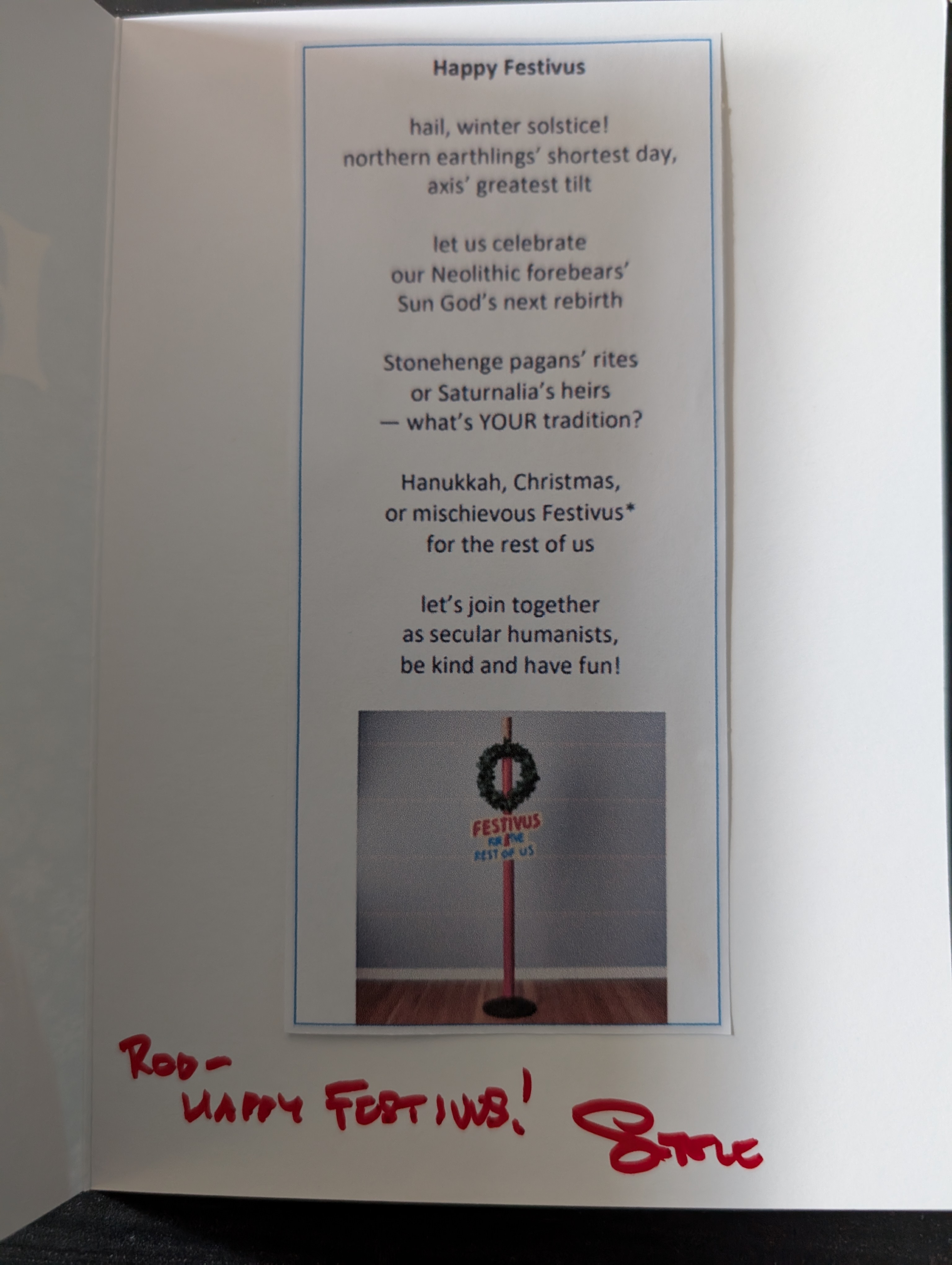
Festivus - Rob, you are quite interested in the Festivus "holiday" which is on Dec. 23.  Below is a picture of a card from Steve.  


And to celebrate (even though you forgot to bring them on the cruise), you and Luke received gifts of personalized potholders.  The pictures on yours and Luke's appear below.  Who doesn't need a photo potholder ?!  Last week, Aunt Di texted me that she "may nor may not have 'borrowed' it".


Christmas for the Rest-Of-Us - We had a traditional Christmas, except a delay on Christmas day since Aunt Pam's car battery died.  Alex, it was so nice of you to drive her back and forth from Dallas.  After a turkey dinner with Steve's brothers Rich and Joe, we opened presents.  Alex, your gifts included books about your namesake Alexander the Great plus Homer's poems the Iliad and the Odyssey.  And you gave me a "Tasting History" book by Max Miller whose Tasting History videos you enjoy.  I'm having an interesting time reading about ancient foods; as of yet, I'm not sure whether I'll attempt making any of the correlating modern recipes suggested by Chef Max.


January Birthday Celebration - Early in January we went to Mizu Sushi for a hibachi dinner to celebrate December (Alex) and January (Aunt Pam and me) birthdays.  Then we headed back to Montgomery Ave. for my first homemade rum cake and ice cream.  Glad we had this time together !!  I took pictures per request from Grammie, who wants new photos for the orange tree she decorates at Christmas.  Here they are:

Spring Semester Gala - Rob, you weren't home for Festivus or Christmas.  So there was a new event, the Spring Semester Gala, shortly before the end of your winter break.  We hope you like the ACLU membership from Steve and other practical items.....  various supplies, including a light cordless vacuum for litter clean-up.  


Kitty Updates - Oren and Grimm enjoyed our mostly-empty bedroom after painting was completed in mid December.  No more floral wall paper!  It's now fresh and bright, with new sconces.  Super happy to have this final "big" remodeling job done, which was possible since we had 2 other bedrooms to temporarily put furniture and other stuff.  One other MAJOR change has been that Oren went away with you Rob to become a Copper Beech Commons apartment cat....  as shown in the second picture below.  The beginning was not easy, but you texted me that Oren is now adjusting well.  Your roommate Ben definitely likes him, hopefully Connor does too.  It will be lovely for us to have time with Oren again during your spring break in March.


Tuesday, December 31, 2024

The Original Boy Band (child of the 70's)

My earliest sense of American pop culture is from the mid-1970's.  Horrible orange and green colors, ugly bell bottom pants and unappealing geometric patterns.  And excitement about the Motown group The Jackson 5, including the youngest boy Michael - an incredibly talented singer and dancer.  I was also aware of the Osmonds, but in Philadelphia they weren't such a big deal (except maybe for the Donny & Marie TV show).

From my point of view, The Jackson 5 are the original, classic boy band.  They had their own special magic, and kids in Philadelphia were fascinated with them - I think, in part, because they were successful black performers.  Michael Jackson went on to be an amazing musician and riveting dancer, but had a troubled adult life and passed away almost 15 years ago.  Earlier this year his older brother Tito died.  Following Tito's death, I enjoyed watching You Tube videos of many performances.  Here's one of the best ones, from 1970 when Michael was about 12 years old:


From your childhood, I have fond memories of coming to pick you boys up at Cookie Corner where Mrs. Brenner or Miss Tossi (later Mrs. Tabone) played pop music during free play.  Here's a great song from a 90's boy band, NSYNC.  I love the theatrical opening, with guys dropping down to the stage on "puppet strings".


Sunday, December 29, 2024

Year-End Updates

Guys, it's time to catch up on your "doing's" as 2024 is winding down.  It was a busy, mostly happy year.

Alex - First of all, today is your Birthday!!  28 years!  As each birthday comes along (yours and mine), I wonder how so much time could have passed so quickly.  Below are your hospital, newborn picture and a cute photo from the summer of 1997 in the yard at Grandma's house.  You were an adorable baby, kind of elf-like.


In other news...  you got 2 AZEK employee turkeys this year.  So Aunt Pam roasted one for Thanksgiving, then Steve & I cooked the other (stored in your freezer) for Christmas.  You always keep busy at work, and are now enjoying a long weekend off through New Year's.  This fall, you thoughtfully tied dry flies for Noel and Larson to fish with next year.  The treadmill in our front hallway was moved to your dining/exercise room.  I'm happy you're using it, and that we have more space in our entry way.  Also, Steve re-attached the screendoor to your back door - so it closes properly.  AND the leak down the sewer pipe into your basement has stopped, after a suggestion from one of your friends to turn off the water to your 2nd floor toilet.  Woo Hoo !!  The plumbing problem up there can be fixed later.  Thank goodness, no more catching water under the sewer pipe then filling a bucket to dump upstairs (or worse, mopping up water on the basement floor).


Rob - Life transitions are not always easy, and after moving to Syracuse you missed especially Oren a lot.  But in September you got off to a decent start, including time Lake Skaneateles with Ellen, Dave & George and an SU football game.  Below is Ellen's 2024 Christmas card.  Unfortunately, you are not a football fan and told me the seats were so high that you felt nauseous plus it was far too loud.  Now you know!  Once I went to a University of Pennsylvania vs. Yale game with Grandad, that was kind of fun - similar to a high school football game.  Then later while Uncle Jason was at Penn State, Dad and I went to a football game with him at State College.  We sat shoulder-to-shoulder in the bleachers, which I did not enjoy.  But it was quite an experience, I'm glad I went once and expect will never do it again.  


Soon we discovered that your 2008 Nissan Altima had a fatal (transmission) problem.  This was after spending $1,400 on repairs in August - so it would be ready for a stint in Syracuse 😠  So Rob, you borrowed my car for a month or so.  Upon asking what kind of newer car you wanted, your reply was "a sedan".  LoL!  We are super, incredibly lucky that Steve loves car shopping.  He tracked down several potential vehicles doing on-line searches at local dealers, and we picked a newer Buick at Gaughan Auto in Taylor.  It's a 2015 Buick Verano with about 77,000 miles.  Quite comfortable, has a rear-view camera and handles well.  

Unfortunately...  you got sick before your fall break.  Your nasty virus turned into pneumonia when you got home, diagnosed on your 2nd visit to Urgent Care in 3 days.  To make things worse, you had a mild (but very uncomfortable rash) allergic reaction to one of the antibiotics prescribed to treat it. You spent a week at home, also missed 7 days of classes.  Of course, Steve and I both got sick within the next week.  Steve had pneumonia while I had bronchitis.  It's quite miserable, you need to avoid the Syracuse Pestilence !!  In better news, Rob you slowly got better and caught up on class work for 4 out of 5 courses. The last one, a Calculus class did not work out (video files from recorded lectures were corrupted), so you'll re-take it in the spring.  You told me your favorite school activity was making paper in the lab, and you love being in control of your own daily routine.  I'm happy that you get along well with your room mates, particularly Ben.  I'm very grateful to Ellen for being your mentor. 

Grimm - Well, in late September we adopted another kitty from St Cats & Dogs in Scranton.  Our goal was to pick a less-adoptible cat, and we ended up with a "teenager" 10-month old tuxedo cat.  Grimm, his shelter name, was shy at the shelter but is a bundle of energy here.  Do not try picking him up!  Alex's room was set up as a kitty haven for isolating then beginning to socialize with his older buddy Oren.  Grimm loves playing with Oren, who is getting more exercise than usual, and will miss him terribly when Oren moves to Rob's apartment in Syracuse.  We're thankful Grimm's not interested in climbing the Christmas tree.  Here are a couple recent shots.


What's next ?  I will write a separate post about holiday/birthday times together and Rob's Mediterranean cruise.  


Wednesday, October 9, 2024

Alex - Why You Are Special (reprise)

Alex...  You were just promoted at AZEC.  I'm so happy that your work has been challenging and rewarding!  AZEC is obviously a great fit for you, and it's clear the Human Resources team has good leadership.  Here's the chronology.....

My email at the bottom of this post is from Dec 2021, when you were in the throws of job searching (not fun!).  It reflects your unique strengths and opportunities that could come from them.

You were hired to AZEC in June 2022.  Here is what you texted me on your second day:  "Everyone is so positive and friendly.  I really like it so far and there's going to be lots of opportunity for me to move up.  I met the plant manager and he was telling me there's people who've worked 4 or 5 different careers in the company and that they prioritize internal hires above external.  So I'm excited and I think there's a lot of potential."  

In April 2023, you were promoted to HR Admin Level 2.  That was quick!  You texted:  "So got the promotion today.  Not quite what I expected as they're keeping me hourly as an admin level two and moving me to exempt towards th eend of the summer.  So I'm skipping the generalist and coordinator role if I'm understanding correctly."

About a month ago in Sept 2024, you were promoted again.  You are obviously a valued member of your team and are being recognized accordingly.  Your text to me was "Signed offer letter today.  Associate HRBP".  Plus you're working on an HR certification (SHRM, I think).  Congrats !!  The Dilbert comic above does make me laugh.


From: Christine Rivers
Sent: Monday, December 6, 2021 8:17 PM
To: Alex.carroll73@yahoo.com <Alex.carroll73@yahoo.com>
Subject: Why you are special
 
Hi Alex

I'm writing this email because it seems like the best way to share these thoughts with you.   On the career front.....  in addition to being a hard worker, you have a gift that you may not recognize.  In fact, it's already evident by your involvement in the Cemetery Association & getting "promoted" to president within a couple years !!  You are great with people, and this will continue to open doors for you in the future.

I have probably told you this before...  When you were under a year old and at the CDC in West Pittston, the teachers told me that you always greeted moms & dads coming to pick up their kids.   The teachers told me that you were very social - if parents didn't say hi, you would make a fuss until they talked to you.  Fast forward to today, and I think that you are able to relate to & talk to almost anyone.  Uncle Jason has that same skill.  Here's why it matters so much - you can talk to more junior people and understand their concerns & issues, plus you can talk to management and understand their objectives & priorities.  You can write well, speak well and also have presence - meaning that when you speak, people can easily focus on you. This will give you opportunities in every organization where you work.  (You could consider setting your sights on labor relations, which could mean a career in Human Resources, it could mean going to law school, or it could mean working within a union and becoming a shop steward.) 

This is not a surprise, you inherited these skills from your Dad (a politician), your grandfathers who both have the gift of public speaking in different ways - plus your grandfather Carroll worked his way up in the army from an enlisted man to general and could connect with all members of the battalion.   Grandad reminded me at Thanksgiving that his grandfather Charles McCausland (Grandnana's father) was a foreman in a woolen mill in Webster and a union man.  You might be interested to talk about it with Grandad when you see him at the cabins. 

Besides thinking about what job you apply for, think equally about what organization you would be happy to work in.  Plus where you will be physically active and/or work with your hands at least part of the time (post office, manufacturer like Benco Dental, a grocery store like Aldi's or Wegman's which are recognized for being good workplaces).  You can start at any job then watch for chances to post so you get experience in multiple roles & advance.  You will sometimes have to challenge yourself and get outside your comfort zone - though this can be stressful in the short term, I have found it usually works out.  Don't be intimidated by the job search process (which is a necessary evil), you have So Much to offer !!!

Love you, Mom


Monday, September 23, 2024

Edie McCausland

It was a sad weekend, and I'm grateful that you both came to Webster for Edie's burial service.  You each made a long drive (alone) from West Pittston and Syracuse.  Thank you for making this time in your busy schedules.  You were special kids in Edie's life, she loved you guys.  You are equally important to her partner Jon, who I'm sure appreciated your presence more than anyone else.  Alex, I'm so glad you came to Hill Street to chat with Jon (Rob, you couldn't since you headed back to ESF the afternoon of the service).  Edie's passing last month was a horrible shock to Jon, and he's struggling with grief, loneliness and the prospect of moving from Hill Street where he's lived more than 25 years.  It was nice that we also had time with Eric, Edie's nephew who made a much longer trip from North Carolina.

Below you'll find a copy of the obituary, a lovely tribute about Edie posted to the funeral home's website, and a eulogy I wrote.  My remembrance was read by the funeral director, who Edie knew and could pronounce the authentic name of Lake Webster.  Rob, I will always remember that you placed the box with Edie's ashes on ground before burial - it's fitting that one of us did that. 

Edith McCausland Obituary

Webster - Edith "Edie" McCausland, age 74, died Thursday, August 15, 2024, at UMass Memorial Health Care, University Campus, Worcester.

Edie was born in Worcester, MA, daughter of the late John B. and Theresa (Hostak) McCausland in lived in Webster all her life.  

In addition to her parents, Edie was predeceased by her sister, Keith "Nikki" McCausland.  She leaves her life-long partner, Jonathan R. Dodge of Webster; nephew, Eric Ewald of North Carolina; a special cousin, Chris Rivers and several other cousins. 

Edie was a graduate of Bartlett High School, Class of 1968.  She was also a graduate of Massachusetts General Hospital School of Nursing, where she earned her degree in nursing, and Clark University  Edie was a registered nurse having worked in the Worcester area her entire career.  She worked at Saint Vincent Hospital and UMass Medical Center.  She retired in 2013.

At her request, there are no calling hours.  Graveside services will be held on Saturday, September 21, 2024, at 11 am in Saint Anthony Cemetery, Webster.  Shaw-Majercik Funeral Home, 48 School Street, Webster, is honored to have been entrusted with Edie's arrangements.  A memorial guest book is available at www.shaw-majercik.com where you may post a message of condolence, share a memory and/or light a candle in her memory.  


Jeannie Cross: Edie was my first – and longest – friend. We grew up next to each other; played together – jacks on her porch, dolls in my basement; walked to school together (starting with Hill Street School and if she was still with us, would probably disown me for posting this picture); go-go danced together (again, would disown me for remembering this); spent teenage summer days at the Town Beach; and kept me in touch with Webster long after I moved away. She was an old soul by 5 or 6 – wise and mature beyond her years… a natural and quiet leader. She helped organize at least one Bartlett ’68 reunion and kept our group of friends connected for decades. Although we went separate paths in and after high school, she made sure we stayed in touch. At her instigation, we attended the Roseland Cottage Crafts Festival a few times with another high school friend. Despite my sorrow at Edie’s passing, I will carry her wit, wisdom and persistence with me. She did much good in her life and now deserves to rest in peace.


Edie McCausland – A Remembrance

I began getting to know Edie about 25 years ago, when we were re-introduced at my grandmother's burial service. My grandmother Phyllis McCausland Rivers is her aunt, so Edie is my father's first cousin. Since the Rivers family is settled in Pennsylvania, there hadn't been many opportunities to spend time together. Edie thoughtfully invited me and my family to visit in Webster.

This was the start of a wonderful relationship with Edie and her partner Jon. They have been incredibly welcoming and generous to us, and truly enjoyed my young son Alex and before long his brother Robby. I have thought of Edie and Jon as their honorary grandparents. There were many weekends staying at their house on Hill Street. We chatted in the living room, at the kitchen table and on the back porch overlooking their lovely yard, often watching the boys play. The Hill Street home was special to us, since it was built by Edie's great grandfather in the late 1800's and has been owned in our family ever since. We had many outings, including to local fairs, museums and Jon's best fishing spots for Alex to try out. Coming from a mid-Atlantic state, during one visit we got a kick out of crossing 2 state lines to have dinner in Rhode Island.

Edie has been an important person in my life, as she was important to everyone here today. She was intelligent, strong and caring with a streak of New England practicality. As a professional in nursing, for years Edie held a responsible, demanding position as a nurse supervisor. She was a frequent patron of the Dudley Library. Edie loved her nephew Eric, who in his childhood spent many summers in Webster.

She had losses and struggles, as we all do. Her father, my great Uncle John, passed away when she was just 22. Edie had an early, brief marriage which ended in a difficult divorce. She oversaw the care of her Mom for several years after a debilitating stroke. This included taking Aunt Theresa out from the nursing facility where she lived to places like Webster Lake (actually, as my grandmother would say, Lake Chargoggagoggmanchauggagoggchaubunagungamaugg). I will always remember Aunt Theresa was delighted to hold my son Robby when he was a baby.

Sadly, Edie lost her sister Nikki in 2015 so became the last surviving “McCausland” in our family. The name McCausland is derived from MacAslan, a founding family of Clan Buchanan of the Scottish Highlands. I'm not certain Edie was interested in this family history, but the heritage lives on in my father David Buchanan Rivers, my brother John McCausland Rivers and my son Robert Buchanan Carroll.

Edie often spoke with me of her longtime friends, nursing co-workers, and her yoga and gym pals. Once she brought me along to a Friday yoga class. And the light in Edie's life was Jon Dodge. He is a wonderful companion – she loved hearing his laugh and listening to his many stories. They were lucky to have 38 happy years together. Jon has been a committed partner, which included bicycling, canoeing, travel and the substantial effort of maintaining the Hill Street property. Jon did everything he could to support Edie during her recent illness.

While we will miss her always, I'm grateful that Edie's physical discomfort and pain have ended and feel sure she's now at peace.

Christine Rivers, Sept. 21, 2024